Silent Wards, Loud Streets: The Political Ping-Pong Paralyzing Kenya’s Healthcare
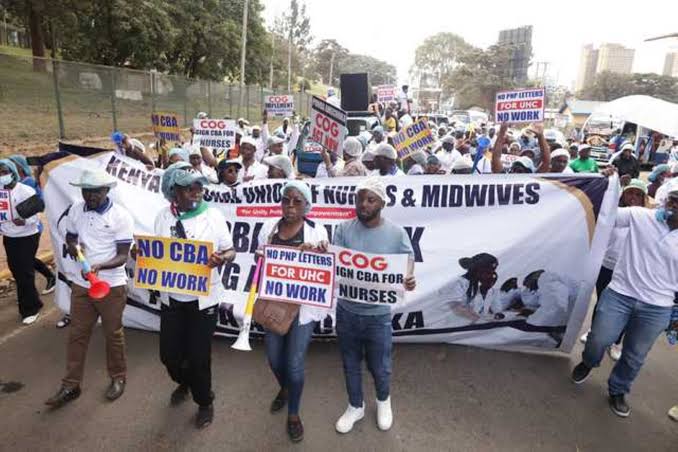
The rhythmic blowing of whistles and the sea of white lab coats flooded the streets of Nairobi this week, signaling a familiar but devastating ritual in Kenya’s public sector: the nationwide nurses' and midwives' strike. Represented by the Kenya National Union of Nurses and Midwives (KNUNM), thousands of health professionals have downed tools, leaving public hospitals as hollow shells of their former selves. From the gates of Afya House to the doorstep of the Council of Governors, the message is clear—the 'White Army' is no longer willing to trade their welfare for empty promises.
In the theater of Kenyan politics, the government treats a signed CBA like a suggestion rather than a contract, proving that while nurses save lives, the state is mostly skilled at reviving excuses.
The crisis, which officially commenced at midnight on Monday, has effectively paralyzed the backbone of the country’s healthcare system. As patients are turned away from the Kenyatta National Hospital and various Level 5 facilities across the 47 counties, the political elite find themselves embroiled in a blame game that has become the hallmark of Kenyan labor relations. At the heart of this standoff is the long-delayed implementation of the Collective Bargaining Agreement (CBA), a document that has gathered dust on government shelves while inflation erodes the meager earnings of those on the frontline of life and death. In Nairobi, the demonstrations took on a particularly defiant tone. Led by the firebrand leadership of the KNUNM, the protesters marched from the Uhuru Park grounds, snaking through the Central Business District toward the Ministry of Health headquarters at Afya House. The chants were not merely for better pay; they were a demand for dignity. The union argues that the government has consistently reneged on its 2017 and 2021 commitments regarding uniform allowances, risk allowances, and the critical promotion of long-serving officers. For many nurses, the strike is a last resort after years of 'diplomatic' letters that yielded no results. Investigative probes into the gridlock reveal a complex web of fiscal finger-pointing. The National Government, through Health Cabinet Secretary’s office, maintains that health is a devolved function, placing the financial burden squarely on the shoulders of the County Governments. Conversely, the Council of Governors (CoG) argues that the National Treasury has failed to release the equitable share of revenue on time, leaving them with 'empty coffers' and an inability to honor the CBA. This political ping-pong has left the Kenyan citizen as the ultimate loser, caught between the bureaucracy of the state and the survival instincts of the workforce. One of the most contentious issues fueling this year’s strike is the fate of the Universal Health Coverage (UHC) staff. These are health workers recruited on short-term contracts during the height of the COVID-19 pandemic. Despite promises to transition them to permanent and pensionable terms, thousands remain in a professional limbo, earning significantly less than their colleagues for the same amount of work. 'We were called heroes when the world was dying, but we are treated like casual laborers when the budget is being read,' one nurse from Mbagathi Hospital lamented during the march to the Council of Governors. As the strike enters its first week, the impact on the ground is harrowing. In rural outposts, where the public hospital is the only available option, maternity wards have been left unattended. Reports from Kisumu, Mombasa, and Eldoret suggest that private facilities are becoming overwhelmed, charging exorbitant fees that the average Kenyan cannot afford. The political optics are worsening for the administration, which has pegged its legacy on a successful healthcare rollout. The strike exposes the fragility of these plans, suggesting that a 'bottom-up' economy cannot function if the 'bottom'—the service providers—is neglected. Labor experts suggest that the government’s strategy of 'wait and see' may backfire. In previous strikes, the state has used court injunctions to declare the industrial action illegal, a move that often leads to the summary dismissal of union leaders but rarely addresses the underlying grievances. This time, however, the KNUNM appears more organized, with a unified front across the counties. The union has made it clear that they will not return to work until the Sh13 billion required to fulfill the CBA is factored into the supplementary budget. Behind the scenes, political analysts view the strike as a litmus test for the relationship between the Executive and the Governors. With the 2027 political cycle looming on the horizon, neither side wants to be seen as the villain who 'killed' the healthcare system. Yet, the reluctance to find a middle ground suggests a deeper fiscal crisis within the country. The National Treasury’s austerity measures, driven by international debt obligations, have left little room for the wage bill increases the nurses are demanding. As the sun set over Afya House on the third day of protests, the stalemate showed no signs of breaking. The police, who had earlier used teargas to disperse a section of the crowd near the CoG offices, stood watch as the nurses vowed to return every morning until their bank accounts reflected the government's appreciation. For now, the corridors of Kenya's public hospitals remain silent, a haunting reminder that in the battle for labor rights, it is often the most vulnerable who pay the highest price. The 'White Army' has retreated to the streets, and the ball remains firmly in the court of a government that must decide if healthcare is a priority or a luxury it can no longer afford.