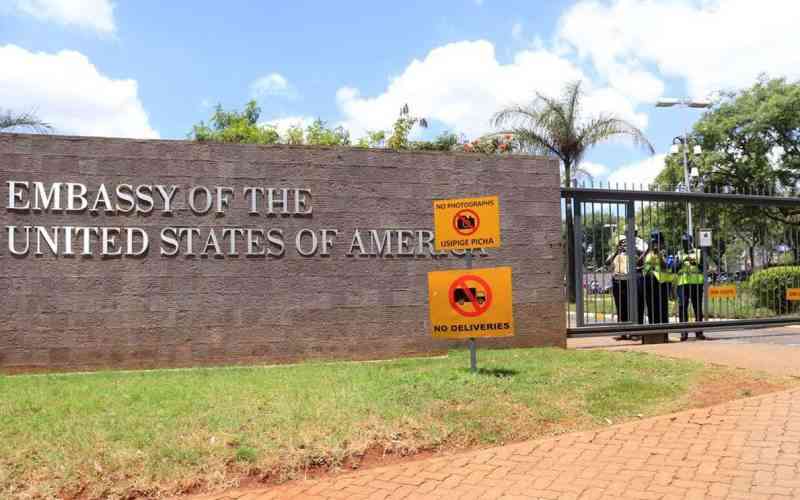
Diplomatic Redlines: Nairobi’s High-Stakes Balancing Act Under U.S. Security Scrutiny
In a move that has reignited the perennial debate over urban safety and international perceptions, the United States Embassy in Nairobi has issued a refreshed travel advisory, maintaining Kenya’s status at 'Level 2: Exercise Increased Caution.' While the overall rating remains unchanged, the granular focus on specific Nairobi neighborhoods—most notably Eastleigh and Kibera—has sent ripples through the city’s political and economic corridors. As the State Department flags concerns over violent crime and the escalating threat of kidnapping, Kenya’s capital finds itself once again at a crossroads between its identity as a regional investment hub and the stark realities of its policing challenges.
In Nairobi, the distance between a high-end diplomatic gala and a 'no-go zone' is often just a wrong turn and a very expensive moment of self-reflection.
The latest advisory from the U.S. State Department is more than a routine bureaucratic update; it is a diagnostic map of the anxieties haunting foreign missions in East Africa. By explicitly naming Eastleigh and Kibera as high-risk zones, the U.S. Embassy has touched a nerve in a city that prides itself on being the 'Green City in the Sun.' The advisory warns American citizens to avoid these areas due to a cocktail of threats: crime, kidnapping, and the latent potential for civil unrest. For the residents of these neighborhoods, the advisory is a bitter pill, highlighting a geographical stigma that complicates the social and economic fabric of the capital. Eastleigh, often dubbed 'Little Mogadishu,' is a sprawling commercial powerhouse contributing billions of shillings to the national exchequer. Its streets are a labyrinth of high-rise shopping malls and bustling warehouses. However, the U.S. security apparatus views it through a different lens—one shaped by counter-terrorism concerns and the historical presence of unregulated financial networks. The mention of Eastleigh in the advisory suggests that despite years of 'Nyumba Kumi' community policing initiatives and increased surveillance, the neighborhood remains a blind spot for traditional security forces, making it a perceived petri dish for opportunistic crime and organized syndicates. Conversely, the inclusion of Kibera—Africa’s most famous informal settlement—speaks to the structural failures of urban policing. In Kibera, the advisory cites the risk of 'crimes of opportunity' such as muggings and home invasions, which often spike during periods of political friction. For the Kenyan Ministry of Interior, the advisory is an unwelcome critique of its 'Reforms in the Police Service' agenda. While the government frequently highlights the deployment of more patrol vehicles and the integration of CCTV systems in the Central Business District, the U.S. report suggests that these security dividends have yet to trickle down to the city’s most densely populated fringes. Perhaps the most jarring aspect of the update is the specific emphasis on kidnapping. Unlike the high-profile maritime piracy of the past decade, the current threat is described as 'express kidnappings'—tactical, short-duration abductions where victims are forced to withdraw cash from ATMs or transfer funds via mobile money platforms like M-Pesa. This shift in criminal tactics has alarmed the expatriate community and middle-class Kenyans alike. Security experts argue that the professionalization of kidnapping syndicates in Nairobi is a direct result of economic desperation combined with a lack of sophisticated forensic tracking at the local station level. The diplomatic fallout of such advisories is always delicate. Historically, the Kenyan government has viewed these warnings as 'economic sabotage,' arguing that they unfairly penalize the tourism sector—a cornerstone of the economy. Government spokesperson Isaac Mwaura and various security chiefs have previously insisted that Kenya is safer than many Western cities, pointing to the successful hosting of major international conferences as proof of stability. Yet, the U.S. Embassy maintains that its primary mandate is the protection of its citizens, and these reports are based on 'rigorous internal intelligence and crime statistics' that often differ from the sanitized versions provided by local authorities. On social media, the reaction has been a mix of defensiveness and grim resignation. 'Kenyans on X' (formerly Twitter) have pointed out the irony of the U.S. issuing safety warnings while grappling with its own domestic mass shooting crises. However, local activists in Kibera and Eastleigh offer a more nuanced view. They argue that while the advisory may be 'alarmist' for foreigners, it reflects a daily reality of insecurity that low-income Kenyans have complained about for years without recourse. For them, the U.S. report is a mirror reflecting a domestic failure to provide uniform security across all socio-economic tiers of the city. From an investigative standpoint, the timing of the advisory is significant. It comes on the heels of several high-profile security incidents and a period of heightened political tension following the 2024 protest cycles. The 'Level 2' status acts as a yellow light for investors; it doesn’t stop the flow of capital, but it certainly increases the cost of doing business. Insurance premiums for multinational corporations rise, and the 'hardship' allowances for diplomatic staff are reaffirmed, further insulating the elite while the targeted neighborhoods suffer the reputational hit. As Nairobi continues to expand, the divide between the 'fortress' suburbs of Runda or Muthaiga and the flagged zones of Eastleigh and Kibera becomes more pronounced. Policing these areas requires more than just boots on the ground; it requires a restoration of trust between the state and the citizenry. Until the Kenyan security apparatus can prove that its jurisdiction extends effectively into the narrow alleys of Kibera and the crowded malls of Eastleigh, the U.S. Embassy’s redlines will continue to define the map of the city for the international community. For now, Nairobi remains a city of 'caution'—a place where the skyline reaches for the future while its streets are held back by the shadows of its unsolved security equations.